

WORK EXPERIENCE
Feb 2017 - Present
ERAU S.U.I.T. Lab:
Daytona Beach, FL
RESEARCH MANAGER
Responsible for managing a team of 5+ students and working with a Principal Investigator to foster current and new research ideas focused on spacesuits and astronaut performance. I have conducted IVA spacesuit operations, data analysis, publication authorship, fundraising and more in this role.
June 2020 - Dec 2020
NASA Johnson Space Center:
(Remote)
SPACESUIT ENGINEER INTERN
As a remote intern I supported the high-pace NASA xEMU spacesuit engineering team in preparation for the first full prototype testing. I drafted testing rigs, revised test procedures, authored technical requirements, and studied the architecture of the entire xEMU project. I was responsible for my own projects and had to frequently communicate virtually with stakeholders to ensure design satisfaction and safety prior to integration.
Aug 2019 - Dec 2019
NASA Johnson Space Center:
Houston, TX
HUMAN FACTORS ENGINEER INTERN
Based on my prior experience in the S.U.I.T. Lab I was tasked with developing Python software and test procedures for the analysis of arm reach envelope in the xEMU spacesuit using motion capture. I was also responsible for conducting anthropometric data collection on human subjects.

S.U.I.T. LAB RESEARCH MANAGER
RESPONSIBILITIES
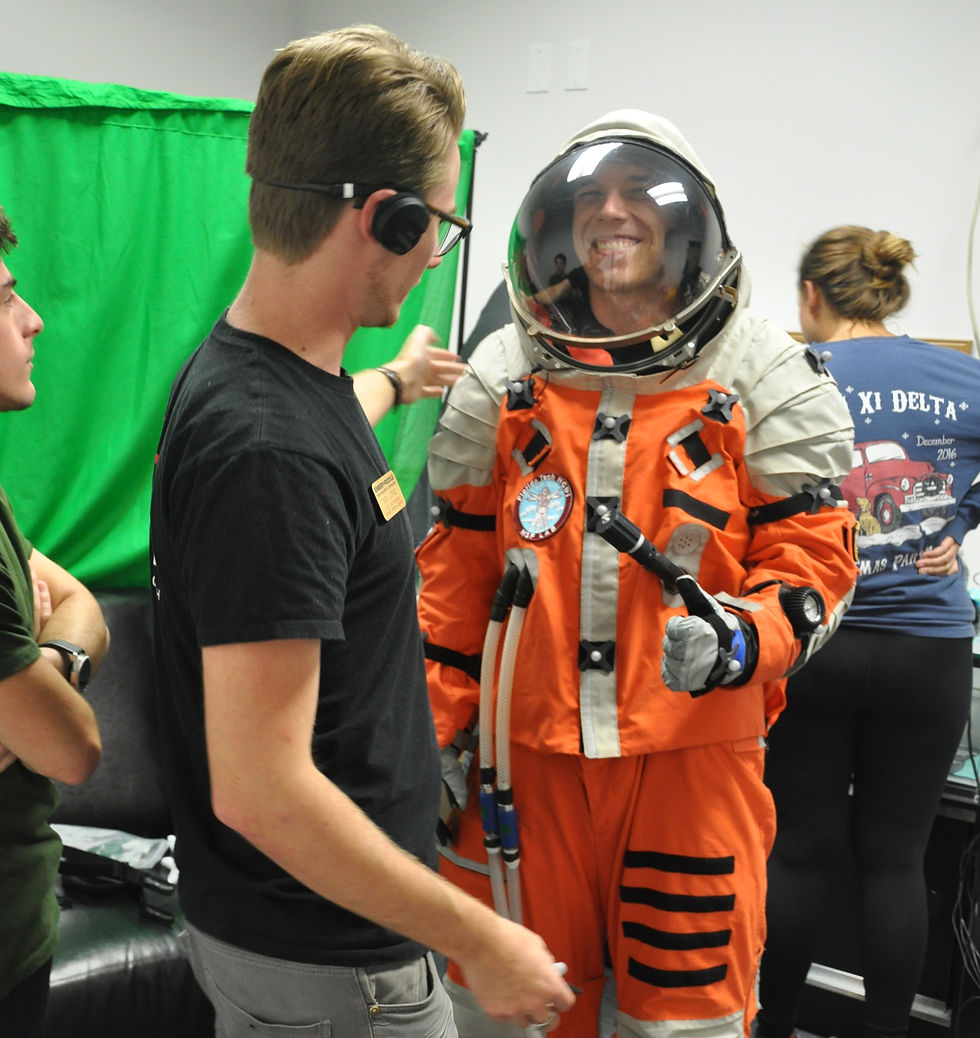
The Embry-Riddle Aeronautical University (ERAU) Spacesuit Utilization of Innovative Technology Laboratory (S.U.I.T. Lab) is my pride and joy. Since I was hired at the founding of the lab, I took on ever increasing responsibilities. I began as a technician responsible for motion capture hardware and software, spacesuit operation, data analysis, and procedure writing. However my passion for the work combined with the empowerment from my Principal Investigator Ryan L. Kobrick PhD allowed me to rise to Research Manager. As research manager I took on many more managerial responsibilities such as fundraising, strategic planning, stakeholder communications, and student team leadership. I would not be where I am today without the lab, and the lab may not have grown so quickly without my contributions.


OUTREACH
My principal investigator instilled the importance of outreach in me at an early point in my career. I frequently shared what major milestones and projects we could on social media. My content creation and video editing skills were constantly employed to create engaging media that showed off our activities. I also attended many volunteer events such as university open houses, Yuri's Night parties, and conferences where I would communicate our research. From this I learned to speak about our work in a digestible manner to people of varying backgrounds and ages. Our outreach work has been rewarding in seeing how impactful it can be on younger people with an interest in spaceflight. Frequent outreach has also brought in new opportunities that otherwise would not have been available to us.
TECHNICAL CONFERENCES
Although we study spacesuits, our research does not occur in a vacuum, our team strives to share the work we do for the benefit of the community. We have had our work published by several technical conferences such as the International Conference on Environmental Systems (ICES), AIAA Space, IEEE, and IAC. I was fortunate enough to have attended ICES on 3 occasions to present our work in person. These experiences have been great networking and learning opportunities for me to exchange knowledge with the human spaceflight community. Click below to see my list of publications.
ANALOGUE RESEARCH
The S.U.I.T. Lab has recognized the great value that spaceflight analogues can bring to the understanding of astronaut performance in isolated and remote locations. I developed remote procedures that analogue crew members could conduct on their own to perform self evaluations on the mobility of their simulated spacesuits. Spacesuit mobility is directly correlated to astronaut performance, and the ability for future crews to perform self assessments in a structured manner will be necessary to ensure successful missions. Additionally I helped develop methods for collecting biometric and location data for simulated EVAs to analyze the correlation between exertion and terrestrial translation. We've worked with analogues worldwide such as: HI-SEAS, MDRS, AMADEE, LunAres and more.
SPACESUIT OPERATIONS
The S.U.I.T. Lab was founded on the study of commercial intravehicular activity (IVA) spacesuit mobility. Developing the methods for empirically analyzing the mobility of a spacesuit has significance to both the designers of a the spacesuit and the vehicle. Our lab utilized pressure suits manufactured by Final Frontier Design, which feature a unique self-regulated pressure valve, and a high degree of adjustability to fit a greater range of anthropometries. I have had experience wearing the suit and performing operations as well as training subjects to perform test procedures while suited.
This video I created highlights the achievements of the S.U.I.T. Lab since I began working there in 2017. Several of my projects and co-workers are featured.

NASA SPACESUIT ENGINEER
RESPONSIBILITIES
As an remote intern on the Advanced Space Suit Pressure Garment Technology Development team, I contributed to the work required to design, develop, and test extra-vehicular activity (EVA) pressure garments for future spaceflight missions. The team has a combination of responsibilities. Currently the majority of the team’s effort is focused on the Exploration Extra-vehicular Mobility Unit (EMU) Demonstration (xEMU Demo). The work includes testing of prototype hardware in the laboratory, Neutral Buoyancy Laboratory (NBL), and other venues to finalize design toward the flight configuration; performing test, analysis, inspections, and demonstrations to verify that design requirements are being met; and preparing for flight operations of the new suit on the ISS and the Moon. Learn more about NASA's efforts with the xEMU below
EXPLORATION EXTRAVEHICULAR MOBILITY UNIT (XEMU)
The xEMU is NASA's next generation EVA spacesuit, purpose built for the Moon. The suit features many improvements over the heritage EMU used on ISS. Standout features include a modular life support backpack, enhanced arm and leg mobility, integrated communications and more. I had the privilege of immersing myself in the xEMU project, which included design requirements, concept of operations, part files, testing procedures and more. I also attended the multi-day Preliminary Design Reviews where I listened to engineers present their work to a board. A keen understanding of the project and EVA systems was important to my success as an intern. I studied the xEMU project and other EVA references to build my expertise on the subject so I could communicate effectively with my teams and formulate my own solutions to complex problems.

MY PROJECTS
Designed a modular ground support equipment test station using CREO to support crewed mobility and joint cycle requirement verification, taking the project through the full design and approval process for laboratory testing at NASA JSC
Developed interface requirements for planetary ladders to ensure compatibility with the xEMU and enforce design safety
Revised and updated standard operating procedures, fit check procedures, and configuration forms for the xEMU
Developed test rig for testing the underwater optical properties of the xEMU helmet in the Neutral Buoyancy Laboratory
Designed architecture for implementing active power lunar boot heaters using the current design of the xEMU
NASA MENTORSHIP
One of the most important aspects of this internship was the mentorship I received from several great NASA engineers. My direct mentor was Amy Ross, she is a legend in the spacesuit community. She has been working on spacesuits at NASA for close to 30 years, and her father was astronaut Jerry Ross. Amy is extremely busy as she leads the entire pressure garment team for the xEMU but still made the time to mentor her interns. She taught me how to work independently yet still maintain good communication on an engineering team. She also reviewed my work constantly and provided input on my designs and authored material to ensure it was up to NASA standards. I also received mentorship from the many engineers who I worked cooperatively with to support several ongoing tasks under the xEMU project.

NASA JSC EC5
EC5 is the thermal and life support systems branch of NASA's Johnson Space Center in Houston, Texas. This branch is responsible for the development of the xEMU EVA spacesuit and the Orion IVA spacesuit. They are comprised of highly skilled design, test, and project engineers that work together to accomplish large scale spacesuit development projects. Often, the branch must coordinate with other branches of NASA such as vehicle and operations development teams to ensure design compatibility and safety. I enjoyed working with many engineers within the branch, and coordinating with other NASA employees on behalf of EC5.

An incredible short documentary on the efforts to make the future of EVA possible. I have had the pleasure of working with many of the individuals featured in this film.

NASA HUMAN FACTORS ENGINEER
RESPONSIBILITIES
I was responsible for assisting the Anthropometry and Biomechanics Facility (ABF) in processing and analyzing motion capture data from spacesuit mobility tests with a focus on the xEMU spacesuit. I worked with the team to develop new and innovative ways to analyze and visualize suited motion capture data using Python, Blender, Excel and other analysis tools. I aided the team in the collection and processing human and suited 3D scan data, as well as developing new ways of analyzing and reporting this data.
HUMAN FACTORS TESTING
The ABF human factors engineers specialize in running tests with humans in the loop. Along with mobility the ABF also seeks to understand the fit and comfort of spacesuits, and how to optimize spacesuit design to prevent future injuries. From my very first day on the team, I found myself lending a hand, and eventually leading tests with multiple subjects. In the lab we were able to collect subject data in multiple ways. I utilized human factors surveys, anthropometric measurement, video recording and 3D scanning to collect data that could later be used to quantify spacesuit fit. Prior to testing I would train test subjects and introduce them to new concepts to ensure safe and effective testing. Following testing I utilized 3D visualization and Excel statistics to compare results across multiple subjects and draw conclusions about spacesuit design.
SPACESUIT MOBILITY
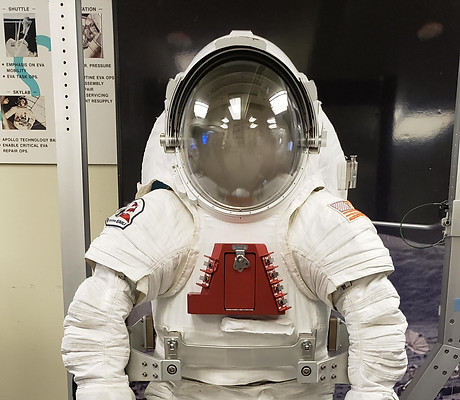
One focus area for the ABF is understanding the relation between the mobility of people and spacesuits. The two must be considered separately, the human moves within the suit, and the suit must move to match the human's movement the best it can while still performing it's life critical functions. The use of video and motion capture to study the motion of humans is a common practice, however this is usually without the bulkiness and abnormalities of a spacesuit. The ABF has a host of custom practices tailored to the analysis of spacesuit mobility built up over years of research. Sometimes without a full spacesuit engineering mockups are used to mimic the limitations of the suit. I frequently worked with the 3D printed mockup of the xEMU hard upper torso pictured below.
MY PROJECTS
Developed Python code for the 3D compilation of reach envelopes for 25 test subjects and analyzed the effects of spacesuit design and anthropometry on reach using Blender to visualize motion capture data and collect measurements
Authored, updated, and executed human subject testing procedures for the recording of motion capture and body scan data used to fit check participants in the hard upper torso and lower torso assembly of the xEMU virtually using CAD
Instructed test participants and crew members during data collection to complete significant functional tasks safely while conducting real time human factors surveys to ensure accurate qualitative & quantitative test results
Provided input and test observations to NASA spacesuit engineers to inform discussion on component design
CUTTING EDGE TECHNOLOGY
The ABF struck me with their high pace of innovation and adoption of new technology. The lab utilized VICON motion capture, Human Solutions 3D laser body scanning, 3DMD photogrammetry, and open source 3D software. More impressively is how the ABF is able to combine all of these methods to be leveraged at once. First the team collects data, this can be through motion capture, or a 3D scan. Collecting multiple scans per person has allowed the ABF to build a large database of test subjects, with a range of anthropometries. The nature of these scans allows measurements to be taken without the presence of the person. It also allows the ABF to test the fit of different spacesuit components virtually on subjects in CAD. Having this technology at my fingertips was exciting, and allowed me to produce unique results in my assigned projects. Mentorship from the ABF team was crucial in building my understanding of their many innovations.


